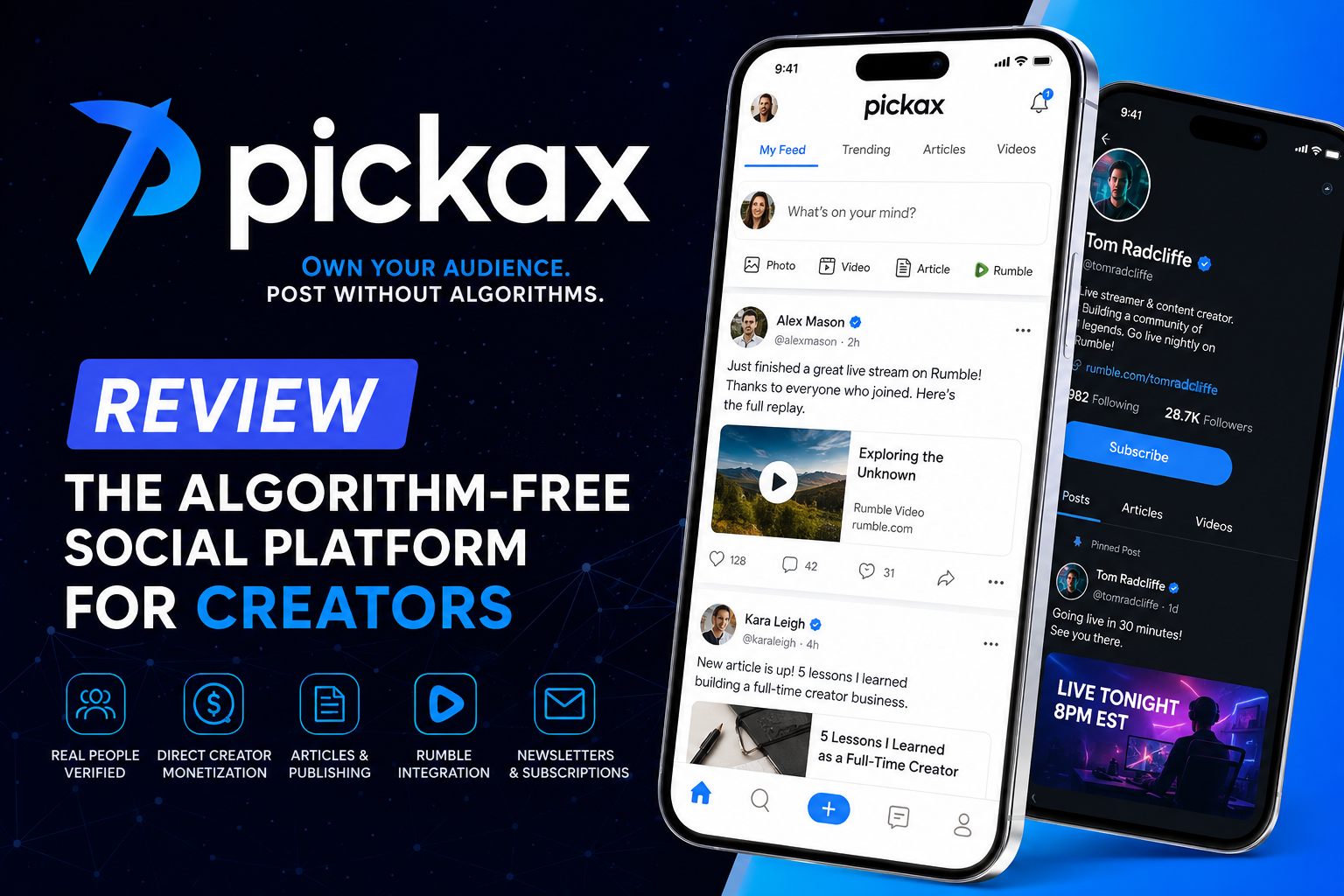
Pickax is trying to do something increasingly unusual in social media: give users more control over what they see, give creators more direct access to their audiences, and reduce the influence of recommendation algorithms. But does a social network built around “no algorithms” actually work?
The social-media landscape has become dominated by platforms that decide what users see through increasingly sophisticated recommendation systems. Facebook, Instagram, TikTok, YouTube, X, and other major networks all rely heavily on algorithms to determine which posts receive attention.
Pickax is taking a very different approach.
The relatively new social platform describes itself with a simple philosophy: “Own your audience. Post without algorithms.” Its pitch is aimed particularly at creators, publishers, independent personalities, and people who are frustrated with the unpredictability of traditional social-media platforms.
Pickax promotes algorithm-free feeds, direct creator monetization, verification intended to distinguish real people from bots, article publishing, Rumble integration, creator subscriptions, newsletters, and direct audience relationships.
But there is an important distinction between having a compelling philosophy and building a social network that people actually want to use every day.
After looking at Pickax’s current features, policies, mobile apps, and early user feedback, there is a lot to like about the concept. There are also some significant questions that the platform will need to answer as it grows.
Here is a detailed look at what Pickax is, how it works, what makes it different, and whether creators should consider adding it to their social-media strategy.
What Is Pickax?
Pickax is a social-media platform designed around the idea that social networking should be more directly controlled by the people using it.
Instead of relying primarily on an algorithm to determine what appears in your feed, Pickax emphasizes following people directly and viewing content through a chronological-first experience.
The company describes the platform as a place where users can follow people, creators, and brands, interact with posts, read articles, watch Rumble videos, and support creators.
The official Pickax website currently promotes several major selling points:
- No algorithms or shadow bans
- Direct creator monetization
- Algorithm-free feeds
- Rumble video integration
- Article publishing
- Creator monetization
- Identity verification
- Direct access to audiences
- No selling of user data
That puts Pickax into an interesting category.
It isn’t simply trying to become another TikTok or X clone.
It is positioning itself as a creator-oriented social network and publishing platform.
That distinction is important.
The Big Idea: What If Your Feed Wasn’t Controlled by an Algorithm?
The central idea behind Pickax is its rejection of traditional algorithmic feeds.
Most large social platforms use algorithms to decide what content deserves your attention. Those systems can consider things such as:
- Previous viewing behavior
- Likes
- Comments
- Shares
- Watch time
- Search history
- Relationships with other users
- Predicted interests
- Trending topics
- Engagement velocity
This can be extremely effective at keeping people on a platform.
It can also create a problem for creators.
A creator might publish something that performs extremely well one day and receive very little exposure from a similar post the following week.
The creator may never know exactly why.
Pickax is attempting to create a different relationship between creators and their audiences.
Rather than asking:
“What does the algorithm think you want to see?”
the philosophy is closer to:
“Who did you choose to follow, and what are those people publishing?”
The Pickax iPhone application describes its feed as chronological-first and says content can resurface through actual human engagement rather than automated ranking systems.
That is potentially one of Pickax’s biggest advantages.
It is also potentially one of its biggest weaknesses.
We’ll come back to that.
Pickax Isn’t Really “No Algorithm” in the Simplest Possible Sense
The phrase “no algorithms” is one of Pickax’s most prominent selling points.
However, users should understand the distinction between not using an algorithmic feed as the primary method of content distribution and literally having no software-based ranking or discovery mechanisms anywhere on the platform.
Pickax currently has areas such as:
- Trending
- Trending Posts
- Trending Articles
- Trending Videos
- Recommended users
- Recommended content
- Premium Feed
Those features necessarily involve some form of organization or selection of content.
The more accurate description is therefore that Pickax is attempting to minimize algorithmic control over the primary social feed, rather than eliminating every automated system from the platform.
That distinction matters.
And honestly, I think this is a better way to evaluate Pickax.
The interesting question isn’t:
“Does Pickax literally have zero algorithms?”
The better question is:
“How much control does the user have over what they see compared with mainstream social networks?”
That is where Pickax becomes interesting.
A Chronological-First Feed Changes the Social-Media Experience
A chronological feed sounds simple.
You follow someone.
They post something.
You see it.
That is fundamentally different from the modern social-media experience where following someone doesn’t necessarily mean you’ll see their posts.
For creators, this can be extremely attractive.
Imagine you are a live streamer.
You announce:
“Going live tonight at 7 PM.”
On an algorithmically controlled platform, there is no guarantee that your followers will actually encounter that announcement.
On a chronological-first platform, the relationship between following and seeing content is much more direct.
That doesn’t guarantee engagement.
It doesn’t guarantee that people will read your post.
And it doesn’t eliminate competition.
But it can reduce one of the biggest frustrations creators have with conventional social networks:
having thousands of followers who seemingly never see their posts.
Pickax Is Particularly Interesting for Content Creators
This may ultimately be Pickax’s strongest market.
The platform appears to be designed with creators in mind rather than treating creators as simply another category of user.
Pickax’s Terms of Service define several account types:
Basic Accounts
Basic users can post, comment, and interact with other users.
However, basic accounts aren’t included in Pickax’s recommended users, trending posts, or trending articles.
Verified Accounts
Verified users go through an identity-verification process.
According to Pickax’s terms, verification involves submitting an image of a current government-issued ID matching the account name, although Pickax says alternative arrangements can be made in circumstances such as pseudonyms, stage names, or business accounts.
Verified users can potentially appear in:
- Recommended users
- Trending posts
- Trending articles
- Other suggested content
Creator Accounts
Creator accounts are verified accounts that have applied and been approved by Pickax.
These accounts may be eligible for monetization features including:
- Subscriptions
- Advertising
- Affiliate programs
- Other monetization tools
- Paid newsletters
- Exclusive articles
- Exclusive posts
This creates a fairly deliberate progression:
Basic → Verified → Creator
That system is one of the more interesting parts of Pickax.
Verification Is a Major Part of the Pickax Philosophy
Pickax is not simply saying:
“Everyone can post anonymously.”
Instead, it is trying to establish a distinction between verified and unverified accounts.
The platform says verification helps keep bots out and emphasizes “real people” and “real reach.”
This is an interesting response to one of the major problems facing social networks today.
Bots, fake accounts, spam accounts, impersonators, engagement farms, and automated content have made it increasingly difficult to determine whether an online audience is actually composed of people.
For creators, that matters.
A creator with 10,000 followers doesn’t necessarily have a 10,000-person audience.
Pickax’s verification system is an attempt to put more emphasis on human identity and authenticity.
However, there is a tradeoff.
Users who want strong anonymity may not like being asked to provide government identification.
That makes verification simultaneously one of Pickax’s strengths and one of the platform’s potential barriers to adoption.
Pickax’s Approach to Monetization
Another major selling point is creator monetization.
Pickax’s website says creators can monetize directly, and its Terms of Service describe several potential monetization mechanisms.
These include:
Paid Subscriptions
Creators can potentially offer subscription-based content.
That can include exclusive posts, articles, and newsletters.
Newsletters
This is particularly interesting.
Pickax allows creators to offer free or paid newsletters to subscribers.
That means Pickax isn’t necessarily limited to being a social-media feed.
It can also become a publishing and audience-retention platform.
A creator could potentially use the platform to:
- Publish public social posts.
- Publish longer articles.
- Build followers.
- Offer premium content.
- Send newsletters.
- Develop a paid subscriber relationship.
That begins to look less like traditional social media and more like a combination of:
social network + publishing platform + creator subscription service.
Why Newsletters Could Be a Big Deal
One of the biggest problems with social media is that creators don’t necessarily own their relationships with their followers.
If your audience exists entirely on a social network, the platform controls the infrastructure between you and that audience.
Change the algorithm and your reach can change.
Change the rules and your content strategy may need to change.
Lose the account and your relationship with that audience can be severely disrupted.
Email newsletters provide another layer of direct communication.
Pickax explicitly supports creator newsletters, including paid newsletters. Its privacy policy also explains that email addresses are used to deliver creator newsletters and subscription-related communications.
For professional creators, that could be more valuable than another feed.
Rumble Integration Is One of Pickax’s Most Interesting Features
This is especially important for creators already using Rumble.
Pickax promotes full Rumble video integration, and both its iOS and Android listings specifically mention the ability to watch and share Rumble videos within the Pickax newsfeed.
That makes Pickax unusual.
Rather than forcing creators to abandon another video platform, Pickax can function as a social layer around Rumble content.
A Rumble creator could potentially use Pickax for:
- Community posts
- Announcements
- Articles
- Audience discussion
- Rumble video promotion
- Subscriber content
- Newsletters
- Social networking
That combination could make Pickax particularly attractive to the Rumble creator ecosystem.
For someone who already publishes on Rumble, there is much less friction in adding Pickax to the workflow.
Pickax Could Be Particularly Useful for Live Streamers
This is where I think the platform becomes especially compelling.
Live streamers have a strange problem.
Their primary content may happen on a streaming platform such as Rumble, Twitch, Kick, or YouTube.
But they still need a social network to communicate with viewers between streams.
Traditionally, creators use:
- X
- Discord
- TikTok
- YouTube Community
- Threads
Each one has its own audience and algorithm.
Pickax potentially gives creators another home for:
“I’m going live.”
“Here’s what happened on the stream.”
“Here’s tomorrow’s schedule.”
“Watch this clip.”
“Read my new article.”
“Join my newsletter.”
“Subscribe for exclusive content.”
For smaller creators, this could be especially useful because the platform’s emphasis isn’t entirely centered around already-viral accounts.
The Creator Advantage: Direct Audience Access
The phrase “own your audience” is central to Pickax’s marketing.
That doesn’t mean creators literally own the platform’s infrastructure or their followers’ personal information.
It means Pickax is attempting to give creators a more direct relationship with the people who deliberately chose to follow them.
This is an important distinction.
The creator doesn’t have to rely entirely on:
“Hopefully the algorithm recommends me.”
Instead, the relationship starts with:
“This person chose to follow me.”
That is a healthier foundation for a creator community.
Articles Are Another Major Feature
Pickax isn’t limited to short social posts.
The platform includes article publishing and an Article Library.
The current web interface includes:
- My Feed
- Premium Feed
- Trending
- Article Library
- Subscriptions
- Verification
- Documents
- Trending Posts
- Trending Articles
- Shorts beta
That makes Pickax interesting for writers, journalists, commentators, educators, reviewers, and creators who want to publish longer-form material.
It also gives creators another potential discovery path.
A person doesn’t necessarily have to discover you because of a 20-second video.
They might discover you because of an article.
That article can then lead them to your profile and other content.
Pickax Is Trying to Combine Multiple Types of Content
One of the most interesting things about Pickax is that it doesn’t appear to be focused exclusively on one media format.
The platform supports or is developing:
- Short social posts
- Articles
- Videos
- Rumble content
- Newsletters
- Paid content
- Subscriptions
- Comments
- Messaging
- Profiles
- Creator content
There is also a Shorts beta visible on the current platform interface.
That suggests Pickax is continuing to expand beyond its initial social-feed concept.
The “No Data Selling” Pitch
Privacy is another important part of Pickax’s marketing.
The company’s homepage explicitly promotes:
“No data selling.”
Its privacy policy says Pickax will not use, sell, trade, or otherwise share personally identifiable information with outside third parties without advance notice, except in circumstances described in the policy.
However, users should still read the complete privacy policy rather than treating a marketing statement as a guarantee that no information is ever shared with any outside organization.
Pickax says it can use third-party companies and service providers to operate the platform and perform functions such as analytics.
The privacy policy also explains that information may be collected when users register, subscribe to creators, communicate with the platform, or interact with the service.
So the better takeaway is:
Pickax’s stated business philosophy is significantly more privacy-conscious than many users may expect from a social network, but users should still understand the actual data practices described in its privacy policy.
One Important Privacy Consideration: Verification
There is another issue worth discussing.
If you want verification, Pickax says you may need to submit government identification.
That creates an obvious privacy consideration.
You are trading:
greater account authenticity and platform visibility
for:
providing additional identity information to the platform.
That’s not inherently good or bad.
It’s a decision users should make deliberately.
Creators using pseudonyms or business names should also be aware that Pickax specifically addresses these situations in its Terms of Service and says users can contact support regarding verification when the account name does not match the government ID.
Pickax’s Biggest Strength: Its Philosophy Is Easy to Understand
Many social networks have complicated explanations for why their platform is different.
Pickax’s pitch is remarkably simple:
No algorithms.
No shadow bans.
Direct monetization.
Real verification.
Direct audience access.
That simplicity is valuable.
The platform isn’t trying to convince users that it has invented an entirely new form of communication.
Instead, it is trying to remove some of the things users increasingly dislike about established social networks.
But There Is a Catch: Algorithm-Free Doesn’t Automatically Mean Better
This is probably the biggest criticism that needs to be made.
Algorithms exist for a reason.
They help users discover content.
If you follow 50 people and 20 of them post throughout the day, a chronological feed can become extremely busy.
And if you don’t follow many people, you may simply have nothing to see.
That creates the classic problem faced by nearly every new social network:
You need users to create content, but users need content before they have a reason to join.
Pickax cannot completely escape this problem.
The Network-Effect Problem
Facebook became valuable because everyone was already there.
Twitter became valuable because everyone was already there.
TikTok became valuable because there was already an enormous amount of content.
YouTube became valuable because creators were already producing massive amounts of video.
Pickax doesn’t yet have that scale.
This is probably its biggest weakness.
Some early Android reviewers have specifically commented on the relatively small user base and difficulty finding enough people to follow. One reviewer described the experience as stagnant and said there were relatively few users appearing in their feed.
That criticism makes sense.
An algorithm can compensate for a relatively small social graph by constantly finding content for you.
A chronological social network can’t manufacture an active community.
Early User Reviews Are Mixed
The early reviews of Pickax are interesting because they reveal both sides of the platform.
The iOS App Store currently shows a very high rating, although the number of ratings remains small.
Positive reviewers frequently praise:
- The lack of algorithms
- Verification
- Creator monetization
- Free posting
- The platform’s philosophy
- The connection with other users
Meanwhile, Android reviews are considerably more mixed.
Some users have complained about:
- An awkward interface
- A small community
- Limited content discovery
- Notification issues
- Verification problems
- An early-stage feeling
That doesn’t necessarily mean Pickax is a bad platform.
In fact, it may simply reflect the reality that users are experiencing an early-stage social network while it is still being developed.
The User Interface Is Probably Pickax’s Biggest Weakness Right Now
The concept is polished.
The product itself is still maturing.
That distinction matters.
Some early Android users have described the interface as awkward or “janky,” while others have reported signup, notification, or navigation problems.
That is exactly the kind of criticism I would expect from a young platform.
A social network can have an excellent philosophy and still have rough edges.
And Pickax currently appears to be in that phase.
The good news is that this is a problem that can be fixed.
The much harder problem is creating a large, active community.
Pickax’s Business Model Is Worth Watching
Another interesting aspect of Pickax is that its stated philosophy doesn’t appear to depend entirely on the traditional advertising model.
The company promotes creator monetization through subscriptions, advertising, affiliate programs, and other tools.
That creates an interesting possibility:
Instead of maximizing time-on-platform at all costs, Pickax can potentially focus more heavily on helping creators develop direct economic relationships with their audiences.
That is a fundamentally different incentive structure.
At least in theory.
Whether that business model can support a large social network remains one of the biggest unanswered questions.
Pickax vs. Traditional Social Media
Let’s simplify the differences.
| Feature | Traditional Social Platforms | Pickax |
|---|---|---|
| Algorithmic feed | Common | Reduced emphasis |
| Chronological content | Usually secondary | Core concept |
| Creator monetization | Available | Major focus |
| Identity verification | Varies | Central feature |
| Article publishing | Varies | Built in |
| Paid subscriptions | Common on major platforms | Supported |
| Newsletters | Usually separate | Integrated |
| Rumble integration | Usually external | Built in |
| Direct audience relationship | Limited by algorithms | Core selling point |
| Small-community discovery | Usually strong algorithms | Current challenge |
| Mature ecosystem | Yes | No |
| Established user base | Large | Still developing |
The biggest difference isn’t necessarily a specific feature.
It is the philosophy behind the platform.
Pickax vs. X
X is still fundamentally a massive real-time conversation network.
Its greatest advantage is scale.
If something happens in the world, there is a good chance thousands or millions of people are already discussing it on X.
Pickax doesn’t have that scale.
But Pickax potentially offers creators a different relationship with followers.
If your priority is:
breaking news and enormous conversations
X has a major advantage.
If your priority is:
building a smaller, direct relationship with an audience
Pickax becomes much more interesting.
Pickax vs. Facebook
Facebook’s enormous advantage is its ecosystem.
Groups, pages, events, marketplace, messaging, personal profiles, communities, advertising, and a massive user base make Facebook extremely difficult to compete with.
Pickax cannot realistically compete with Facebook feature-for-feature today.
But it doesn’t need to.
Pickax is attempting to provide something Facebook increasingly struggles to provide:
a feeling that the user is actually in control of the feed.
Pickax vs. Instagram
Instagram is overwhelmingly visual and increasingly centered around recommended content.
Pickax is more publication-oriented.
The ability to publish articles, write posts, share videos, communicate with followers, and build subscriptions makes Pickax feel closer to a hybrid publishing platform.
Instagram remains dramatically more powerful for visual discovery.
Pickax’s advantage is control and direct communication.
Pickax vs. TikTok
TikTok’s greatest strength is discovery.
You can create an account with zero followers, publish a video, and potentially reach enormous numbers of people.
That’s incredibly powerful.
It is also the opposite of Pickax’s core philosophy.
TikTok asks:
“What content should we show you?”
Pickax’s philosophy is closer to:
“Who do you want to follow?”
For viral discovery, TikTok has a massive advantage.
For intentional audience building, Pickax’s model is potentially more attractive.
Pickax vs. Rumble
This comparison is particularly interesting.
Rumble is primarily a video platform.
Pickax is primarily a social and publishing platform with deep Rumble integration.
They can therefore complement one another.
A creator might:
Stream on Rumble → publish the video → share it on Pickax → discuss it with followers → publish an article → send a newsletter → build subscribers.
That makes Pickax less of a Rumble competitor and more of a social layer surrounding Rumble content.
That could become one of its most important niches.
Who Should Use Pickax?
I wouldn’t recommend Pickax equally to everyone.
There are certain types of users who could get significantly more value from it.
1. Live Streamers
This is one of my favorite use cases.
If you stream on Rumble, Twitch, Kick, or another platform, Pickax can provide another location for announcements and community interaction.
2. Independent Creators
Creators who don’t want their entire business dependent upon one major platform should consider establishing a presence early.
3. Writers
The article-publishing system makes Pickax interesting for writers and independent publishers.
4. Podcasters
Podcasters can use Pickax to build a community around their shows and direct followers toward episodes.
5. Rumble Creators
This may be one of the strongest target demographics because of the native Rumble integration.
6. Political and Cultural Commentators
Pickax’s emphasis on direct publishing and reduced algorithmic control may appeal to commentators who want another distribution channel.
That said, users should not confuse “less algorithmic control” with a complete absence of content moderation.
Pickax’s own Terms of Service explicitly state that it is a private company and retains the ability to remove content that violates its policies.
7. Businesses and Brands
Small businesses could potentially use Pickax as another direct communication channel.
However, the platform’s current user base is not yet large enough to make it a replacement for established advertising platforms.
Who Probably Shouldn’t Switch to Pickax Yet?
If your entire social-media strategy depends upon viral discovery, Pickax may disappoint you.
TikTok, YouTube Shorts, Instagram Reels, and similar platforms have massive recommendation engines capable of exposing creators to people who don’t follow them.
Pickax’s model is different.
You are likely going to get more value if you think of Pickax as:
an audience-building and community platform
rather than:
a viral-content lottery.
That distinction is crucial.
The Biggest Opportunity for Early Adopters
There is an enormous advantage to joining a social network before it becomes crowded.
The creators who establish themselves early can potentially build recognizable usernames, communities, and relationships before the platform becomes saturated.
Pickax currently appears to be in precisely this stage.
Its official Pickax account had more than 6,600 followers when recently crawled, while specialized accounts such as Pickax Creators and Pickax Gamers had smaller audiences.
Those numbers aren’t enormous compared with established social networks.
That’s exactly why they are interesting.
Early creators have an opportunity to become visible within the ecosystem while it is still relatively small.
The Early-Adopter Strategy I Would Recommend
I wouldn’t recommend abandoning your existing social accounts.
Instead, use Pickax as an additional distribution channel.
A good strategy would look something like this:
Step 1: Claim Your Username
Get your preferred username before someone else does.
Step 2: Verify Your Account
If you are comfortable with the verification process, verification can increase your eligibility for recommendations and trending features.
Step 3: Complete Your Profile
Use the same branding across your other platforms.
Step 4: Follow Relevant People
Don’t just follow massive accounts.
Find creators in your niche.
Step 5: Publish Consistently
Don’t create an account and disappear.
Step 6: Repurpose Existing Content
Turn existing material into:
- Short posts
- Articles
- Video shares
- Announcements
- Commentary
- Questions
- Poll-style discussions
- Newsletter content
Step 7: Connect Pickax to Your Existing Ecosystem
Your website, Rumble channel, Twitch channel, YouTube channel, newsletter, Discord, and other social profiles can all work together.
Pickax should be treated as another piece of the ecosystem.
Don’t Make the Mistake of Treating Pickax as a Replacement for Everything
This is probably the most important recommendation I can make.
Do not delete your existing social accounts simply because Pickax looks promising.
Social media is about distribution.
Every platform has a different audience.
If you’re a creator, having an account on Pickax doesn’t mean you need to stop using:
- Rumble
- Twitch
- YouTube
- X
- TikTok
- Discord
Instead, think of Pickax as another route through which people can discover and communicate with you.
The Chicken-and-Egg Problem
Pickax’s biggest challenge is going to be community growth.
This is unavoidable.
A social network needs:
Creators → Content → Users → Engagement → More creators
But early on it can become:
Few creators → Little content → Few users → Little engagement → Few creators
This is the challenge Pickax must overcome.
The “no algorithm” model makes the problem even more obvious.
A giant platform can keep users entertained even if they don’t follow anyone.
Pickax needs people to deliberately build their social graph.
That’s not necessarily a bad thing.
But it means Pickax will require a different kind of user behavior.
Why the “No Algorithm” Model Could Eventually Become an Advantage
If Pickax succeeds in growing its user base, its current weakness could become one of its greatest strengths.
Imagine a platform with millions of users where:
- You choose who you follow.
- Their posts appear directly in your feed.
- Creators can communicate with subscribers.
- Articles have their own discovery system.
- Videos are integrated.
- Newsletters reach subscribers.
- Users are verified.
- Creators can monetize directly.
That could be a very compelling alternative to algorithmically dominated social media.
The question isn’t whether that model is theoretically attractive.
It clearly is.
The question is whether Pickax can grow large enough to make it work.
There Are Still Some Important Questions
Because Pickax is relatively new, potential users should recognize that some aspects of the platform are still developing.
For example:
How large can the community become?
This is the biggest question.
How effective will content discovery become?
Pickax needs enough users and content for discovery to feel worthwhile.
How will moderation scale?
A platform promising broad freedom of expression still has to deal with spam, harassment, illegal material, impersonation, scams, and other problems.
Pickax’s Terms make clear that the company retains moderation authority despite its free-speech-oriented positioning.
How will creator payouts evolve?
The platform currently advertises multiple monetization mechanisms, but creators should examine the specific creator agreement and payout terms before treating Pickax as a major revenue source.
Can the company scale the technology?
The early app reviews indicate that the platform still has interface and technical issues to work through.
Pickax Is Still a Work in Progress
This is perhaps the fairest description of the platform right now.
Pickax doesn’t feel like a finished Facebook replacement.
It feels like a new social platform being actively built around a very specific philosophy.
That philosophy is:
People should decide who they follow.
Creators should have more direct relationships with their audiences.
Creators should have more ways to monetize.
Social feeds shouldn’t be dominated by opaque recommendation systems.
Users should be real people rather than armies of bots.
Whether you agree with every part of that philosophy or not, it is refreshing to see a platform take a clear position.
My Overall Review
Concept: 9/10
The concept is excellent.
There is a real appetite for alternatives to algorithm-driven social media, and Pickax has identified that market extremely well.
Creator Features: 8.5/10
Subscriptions, newsletters, articles, video integration, creator accounts, and monetization tools give Pickax considerable potential.
Discovery: 6/10
This is currently one of the biggest challenges.
An algorithm-free environment can make discovery more intentional, but it can also make the platform feel empty when the community is still small.
User Interface: 6/10
The web platform is functional and feature-rich, but early mobile reviews suggest that the user experience still needs refinement.
Community Size: 4/10
This is Pickax’s biggest weakness today.
The platform simply doesn’t have the scale of established social networks.
Privacy Philosophy: 8/10
Pickax makes stronger privacy-oriented claims than many mainstream platforms and explicitly says it does not sell personally identifiable information. However, users should still read the actual privacy policy and understand what information is collected and how third-party service providers are involved.
Potential: 9/10
If Pickax can build a large enough creator and user community, the model could become genuinely significant.
Final Verdict: Should You Join Pickax?
Yes — but don’t treat it as your only social network.
For most creators, there is very little downside to establishing an early presence on an emerging platform, particularly when the platform is free to join.
Pickax is particularly worth investigating if you are:
- A live streamer
- A Rumble creator
- A writer
- A podcaster
- An independent publisher
- A commentator
- A small business
- A creator tired of algorithmic reach
- Someone interested in building a direct audience
The biggest reason to join isn’t that Pickax is currently bigger than Facebook, Instagram, TikTok, X, or YouTube.
It isn’t.
The reason to join is that Pickax is trying to solve a problem that those platforms have arguably helped create.
Social media has increasingly become less about:
“Who do I want to hear from?”
and more about:
“What does the platform think will keep me here?”
Pickax is attempting to reverse that relationship.
The Real Test for Pickax
Ultimately, Pickax’s success won’t be determined by how good its marketing sounds.
It will be determined by whether it can answer three questions:
Can Pickax attract creators?
It appears to be doing that.
Can those creators bring their audiences?
This is the next major challenge.
Can Pickax grow those audiences into an active community?
That is the ultimate test.
If the answer to all three becomes yes, Pickax could evolve from an interesting alternative social network into a legitimate competitor in the creator economy.
If it can’t build enough critical mass, the “no algorithm” experience could remain interesting but relatively empty.
The Bottom Line
Pickax is one of the more interesting new social platforms to watch because it isn’t simply trying to copy TikTok, Instagram, or Facebook.
It is challenging the underlying philosophy of modern social media.
Its approach emphasizes:
Chronological-first feeds.
Direct relationships.
Creator monetization.
Identity verification.
Long-form publishing.
Newsletters.
Rumble integration.
Reduced algorithmic control.
No stated sale of personal information.
And while the platform still shows signs of being young — particularly in user population, interface refinement, and content discovery — those limitations are somewhat expected at this stage.
The bigger question is whether Pickax can grow without abandoning the philosophy that makes it interesting in the first place.
For creators, however, the answer is simpler.
You don’t have to choose between Pickax and every other platform.
Get your username. Build your profile. Start posting. Bring your audience over. Experiment with articles, video, newsletters, and subscriptions.
If Pickax succeeds, early creators may be very glad they established themselves before the platform became crowded.
And if it doesn’t?
You’ve still diversified your social-media presence instead of putting your entire creator business in the hands of a single platform.
My verdict: Pickax is worth watching — and for creators, worth joining early.
Sources and Further Reading
- Pickax official website
- Pickax Terms of Service
- Pickax Privacy Policy
- Pickax on the Apple App Store
- Pickax on Google Play
Editor’s note: Pickax is an actively developing platform. Features, monetization options, user counts, policies, and app functionality can change. This review reflects the platform and publicly available information reviewed in August 2026.